
Notifications
9 minutes, 21 seconds
-39 Views 0 Comments 0 Likes 0 Reviews
Within South Africa’s cannabis landscape, much of the attention remains fixed on policy, legislation, and the pace of reform. There is ongoing debate about commercialisation, licensing, and market structure.
Away from these discussions, one part of the system has been steadily moving: The Department of Agriculture.
Its role is often misunderstood. It is not tasked with controlling the entire cannabis industry. It is not responsible for trade, retail, or commercial licensing. Its mandate is narrower, and that is precisely why it is working.
Agriculture is responsible for the foundation. It focuses on cultivation. It creates entry points for farmers. It builds the systems that make agricultural activity stable, repeatable, and capable of scaling. This work is not always visible, but it is essential. Seeds, standards, and cultivation frameworks are not headline issues, they determine how the industry develops over time.
While other parts of government continue to work through policy and legislative complexity, Agriculture has taken a more direct approach.
It has stayed close to the ground.
It has focused on what can be implemented now. That implementation is practical. It is measured in hectares, permits, and planting cycles. It is reflected in farmers entering the system and crops cultivated under a recognised framework.
This movement did not happen in isolation.
Concerns were raised around enforcement friction and the interaction between SAPS and agricultural processes. Engagement followed. To the Department’s credit, it responded. Adjustments were made, and those adjustments are now visible in how the system operates.
The hemp permitting framework has been expanded across all provinces.
Barriers to entry are reduced. Costs are brought down to approximately R700. Requirements that previously limited participation, including certain infrastructure expectations and SAPS-related processes, are removed or softened.
This shifts participation from theory to practice. It allows small-scale farmers to enter the system in a way that was not previously possible. It creates a lawful starting point for cultivation, even if that starting point is currently limited to hemp.
A key development, often overlooked, is the adjustment of the THC threshold for hemp from 0.2% to 2% under the Plant Improvement Act.
This is not a technical amendment.
It reflects a shift toward recognising the realities of cultivation and improving the commercial viability of farming. It reduces the risk of crops falling outside compliance due to natural variation and aligns more closely with how cannabis behaves as an agricultural plant.
At the same time, this change sits within a system that still distinguishes sharply between hemp and higher-THC cannabis, without providing a corresponding framework for the latter.
The result is a regulatory environment where agriculture is evolving in practical terms, while the broader market structure remains incomplete.
Alongside this, the Department has begun developing a formal seed system.
Locally developed varieties such as ARC CAN 001 and ARC CAN 003 are introduced. Seed multiplication programmes are implemented. Training support is extended to both advisors and farmers. The intention is clear: reduce reliance on imported genetics and establish a stable, recognised base for cultivation.
Seed determines the system.
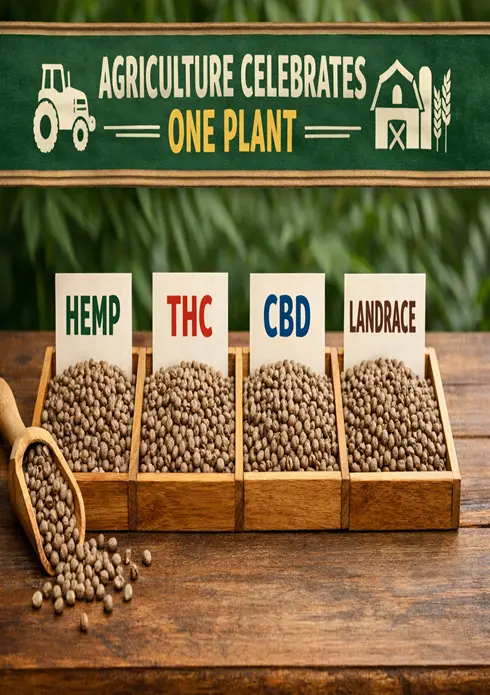
It defines yield, compliance, and consistency. It influences who can participate and under what conditions. South Africa has a deep and diverse base of cannabis genetics, particularly in the form of landrace strains that are cultivated across regions for generations.
These genetics exist at scale and are adapted to local conditions. They are supported by longstanding knowledge systems. They remain outside the formal framework. The current seed system focuses on compliant hemp varieties, while much of the country’s natural genetic base is not formally recognised.
This creates a gap.
The state is building a structured seed system, it is doing so alongside an existing, informal genetic landscape that has not been integrated. This is a partial seed strategy.
Over time, this will matter, since whoever defines the seed, defines the system.
In terms of inclusion, there are early signs of change.
The adjustments to the hemp permitting system indicate a shift in approach, entry is nationally accessible. There is growing recognition within the Department that the current framework does not reflect the reality of cannabis cultivation in South Africa.
Traditional growers are not accommodated and their Landrace genetics not recognised.
Existing cultivation practices remain outside the formal system. However, these issues are now part of the discussion.
There is acknowledgement that future regulatory development should consider regional differences, traditional knowledge systems, and long-standing cultivation practices. This marks a shift from earlier positions where these factors were largely absent from the formal conversation.
The progress is real, but it is not complete.
The Department’s constraint is structural.
Its mandate ends at cultivation. It does not control what happens after harvest. Trade, distribution, and commercial pathways sit with other departments. This creates a clear imbalance.
Cultivation is being enabled, as Farmers enter the system. Production potential is increasing. despite no fully defined legal pathway to move that product into the domestic market. There has been no formal announcement, creating a regulated framework for high-THC cannabis cultivation for commercial domestic supply.
This is the missing piece; it is the space between production and market access. Until that space is addressed, the system remains incomplete. Agriculture can enable supply, but it cannot complete the cycle.
This is not a failure of Agriculture.
It reflects how responsibilities are divided across the system.
The Department of Agriculture is not the bottleneck. It is the part of the system that is operational.
Recent engagements have made DoA direction clear, they are preparing for beyond hemp and bringing the full cannabis plant into an agricultural framework. Ongoing work supports farmers through provincial systems and extension services. There is a clear shift away from unnecessary enforcement and barriers within the agricultural space, like double fencing
What has been done is measurable:
This is foundational work.
The next phase does not sit with Agriculture. It sits with the broader system, where trade, distribution, and market access should be defined.
Until that layer is completed, the progress made on the ground cannot fully translate into economic participation.
The foundation is now in place.
What follows will determine whether that foundation supports a functioning system, or remains an isolated layer within one that is still incomplete.
#H3Framework #CannabisReform #FoodSafety #SouthAfrica #PublicHealth
Charl Botha is a cannabis legal strategist with a B.Proc degree, cannabis policy specialist, and spokesperson for Team H3.(H3 Legal Solutions/H3 Care NPC / Healthpath24. He writes from direct involvement in parliamentary briefings, interdepartmental engagements, and regulatory submissions.
Cannabis H3Framework CannabisReform FoodSafety SouthAfrica PublicHealth





Share this page with your family and friends.