
Notifications
7 minutes, 49 seconds
-50 Views 0 Comments 1 Like 0 Reviews
The role of the South African Police Service is clear. It enforces the law.
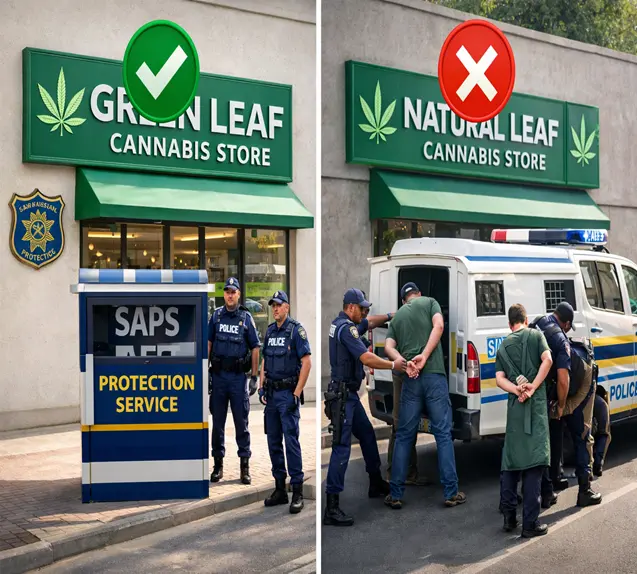
In most areas, that function operates within a stable and well-defined framework. In the current cannabis environment, that clarity is still developing.
The law has shifted, but it has not fully settled. Private use, possession, and cultivation are permitted within defined limits. Medical cannabis operates within a regulated system. Commercial trade remains largely undefined outside of specific licensing pathways. The framework continues to evolve, and its different components are not fully aligned.
This places enforcement in a complex position.
SAPS is required to apply legislation within a system where legal boundaries are being clarified. What is lawful in one context may be interpreted differently in another. The result is uncertainty and complexity in application.
On the Ground
Enforcement now operates in a space that is less clearly defined than before.
An adult may lawfully possess cannabis, cultivate it privately, and access it through a regulated medical process. At the same time, commercial exchange remains restricted, despite being visibly present in various forms across the country.
This creates practical challenges.
Cases may be opened and later withdrawn. Arrests may be contested and reviewed. Outcomes can vary depending on how the law is interpreted and applied in specific circumstances. This is not indicative of failure, but of a framework that is in transition.
Edibles illustrate this particularly well.
Edibles are not a single, easily identifiable product category. Without consistent testing, labelling, or defined standards, classification becomes difficult. At the same time, these products can carry concentrated effects, which introduces legitimate concerns around safety and dosage.
There is currently no fully defined retail framework governing their production, packaging, or sale.
This places SAPS in a position where enforcement must occur in relation to products that are not clearly regulated.
The Position SAPS Operates Within
In practice, SAPS is working within a system where several realities exist at the same time:
Enforcement sits at the intersection of these elements.
The Structural Constraint
SAPS is not mandated to regulate a market. Its role is to enforce the law.
Where legislation is still developing or fragmented across different statutes, consistent enforcement becomes more difficult. This is not a question of capacity or intent, but of legal clarity.
Officers are required to act based on the law as it stands. Where that law does not provide a complete framework, outcomes may vary.
This is most evident in areas such as:
In each instance, enforcement is applied within a space that is not fully defined in legislation.
Policy Signals and Legal Obligation
There is often reference to a “moratorium” or a softer enforcement approach.
It is important to distinguish between policy direction and law.
Policy positions or internal directives may guide how enforcement is approached, but they do not replace legislation. Offences remain defined by statute, and SAPS is required to act accordingly.
This creates a difference between public expectation and legal obligation.
In practice, discretion may be exercised differently across regions or situations. Without uniform legislative reform, this can result in varied application rather than a single, predictable standard.
The Cost of Misalignment
As the framework continues to evolve, legal challenges are frequent.
Where enforcement actions are tested in court, questions may arise regarding the application of rights, procedure, and interpretation. Where findings go against the state, this can result in financial liability.
Individually, such matters are case-specific. Collectively, they indicate a system under pressure to align legal structure with practical reality.
The pattern is consistent:
This underscores the importance of regulatory clarity.
Operational Pressure and Visibility
SAPS operates within a performance-driven environment where visibility and measurable activity are important.
In such environments, enforcement can naturally focus on areas that are more accessible and observable. Cannabis, as a visible and widespread activity, may fall into this category.
This does not suggest impropriety. It reflects how enforcement activity can align with operational realities.
The broader question is whether enforcement focus corresponds with the most effective use of resources within an evolving legal framework.
Systemic Risk in Prolonged Grey Areas
Where a legal framework remains incomplete for an extended period, certain risks increase.
Markets continue to operate. Activity does not pause while regulation develops. In the absence of clear structure, inconsistencies can emerge, and public understanding of the law may diverge from its formal position.
Over time, this can place strain on:
These are structural risks, not reflections on any single institution.
Key Takeaway
SAPS is not the source of inconsistency within the system.
It is where that inconsistency becomes visible.
Enforcement reflects the law as it exists. Where the law is still evolving, outcomes may vary. What would ordinarily be clear becomes subject to interpretation. What should be uniform becomes situational.
The issue is not whether enforcement is too strong or too limited.
It is that the framework being enforced is not fully aligned.
Until legislative clarity matches the reality on the ground, these challenges will continue to surface through enforcement actions, legal challenges, and varied outcomes.
#H3Framework #CannabisReform #FoodSafety #SouthAfrica #PublicHealth
Charl Botha is a cannabis legal strategist with a B.Proc degree, cannabis policy specialist, and spokesperson for Team H3.(H3 Legal Solutions/H3 Care NPC / Healthpath24. He writes from direct involvement in parliamentary briefings, interdepartmental engagements, and regulatory submissions.
MentalHealthAwareness DrugReform SouthAfrica cannabis regulations H3 Legal Solutions HP24 H3 Healthpath24 law enforcement





Share this page with your family and friends.