
Notifications
5 minutes, 29 seconds
-160 Views 0 Comments 1 Like 0 Reviews
Commercial Realities and the Cost of Exclusion
While government remains locked in administrative delay, the cannabis economy continues to develop in plain sight.
Across South Africa, businesses operate openly, commercial properties are occupied, employees earn livelihoods and consumers purchase products without behaving as though they are participating in a prohibited activity. Whatever position government may take on future regulation, one fact is beyond dispute: the industry exists.
This reality exposes the growing disconnect between policy and practice. Entrepreneurs continue to invest capital, sign leases, employ staff and build businesses without knowing what regulatory framework will eventually emerge. Investors are expected to commit resources despite uncertainty over licensing requirements, compliance obligations and future restrictions. Few industries are asked to operate under such conditions for such an extended period.
Every year of delay leaves a mark.
Some losses can be counted in rands. Others disappear before they ever appear in a spreadsheet.
A business idea abandoned. A farmer who chooses a different crop. A promising entrepreneur who leaves for another industry. An investor who never books the flight. A processing facility that finds a home in another country. A generation of opportunity slowly reduced to another discussion about what might have been.
Commercial Realities and the Cost of Exclusion
Cannabis has created businesses, jobs, products and investment opportunities despite years of regulatory uncertainty. Economic activity emerged first. Government's response followed.
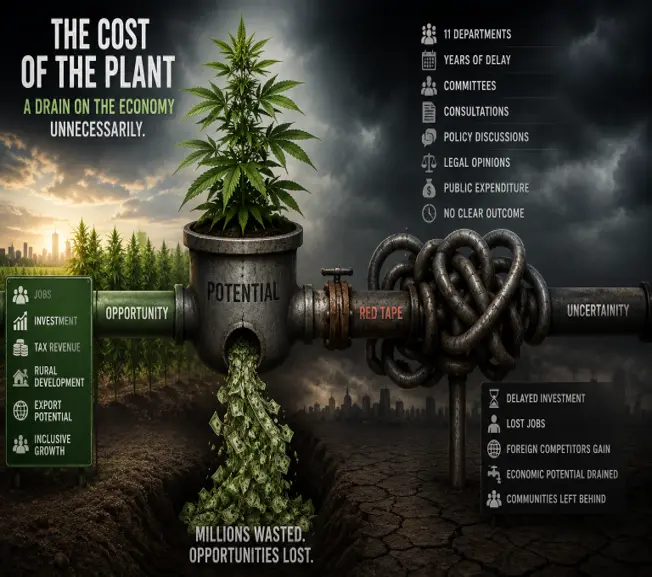
Enormous public resources continue to be consumed by a process that struggles to produce the clarity required for further growth. The contrast becomes increasingly difficult to ignore.
Years of public expenditure measured in the tens, and perhaps hundreds, of millions of rand.
Against this, a simple question stubbornly unanswered: what is delivered? While government has devoted extraordinary effort to the administration of cannabis reform, much of the practical progress has occurred outside the regulatory process. The issue is no longer whether cannabis presents commercial potential. The market settled that question years ago. The issue is whether the public has received value for the time, money and administrative resources already consumed by the process.
Despite these obstacles, the sector continues to expand. This growth demonstrates both the resilience of the industry and the failure of existing policy. An economy that government has struggled to regulate is generating economic activity, supporting employment and contributing to local commercial ecosystems.
Communities with historical relationship to cannabis remain among the most marginalised. Rastafari communities, traditional healers and heritage growers have maintained cultural, spiritual and agricultural relationships with cannabis for generations. Their connection to the plant predates modern commercial markets and extends beyond economics. Cannabis policy discussions are treating these communities as peripheral stakeholders rather than central participants.
Cannabis is discussed as an investment opportunity, an export commodity or an agricultural product. While these considerations are important, they should not eclipse the cultural, spiritual and historical dimensions that form part of South Africa's cannabis heritage. A regulatory framework that recognises only commercial interests risks excluding the communities that preserved cannabis knowledge, cultivation practices and cultural traditions through decades of prohibition.
Inclusion requires more than consultation.
It requires recognising that different communities engage with cannabis for different reasons and that a single commercial model cannot accommodate every legitimate interest. The needs of a multinational exporter are not the same as those of a heritage grower. The objectives of a pharmaceutical manufacturer differ from those of a Rastafari community using cannabis as a sacrament.
The challenge facing South Africa is larger than cannabis regulation. It is a question of whether economic development will be pursued in a manner that includes the people and communities who carried the burden of prohibition, or whether they will once again be asked to stand aside while others benefit. The remaining question is who will be allowed to participate, and why not use existing frameworks instead of pretzel law that is trying to ensure the plant is both criminalized and treated lie a pariah.





Share this page with your family and friends.