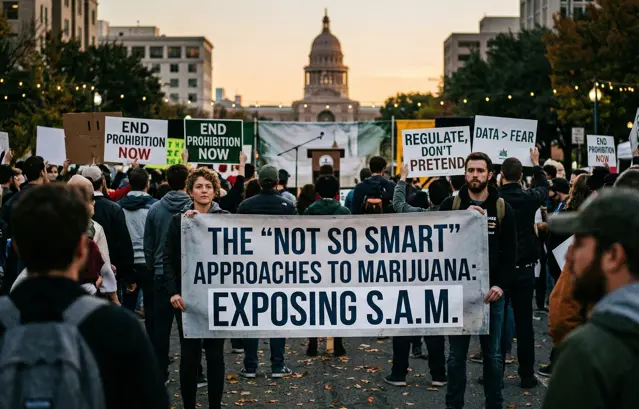
As 2026 legislative sessions wind down, the cannabis industry is still facing an upcoming battle. While the push for common-sense reform is growing, a well-funded opposition is trying to drag us backward. Smart Approaches to Marijuana (SAM) has reportedly spent over $5 million this year on "roll-back" initiatives to keep the failed status quo alive.
Heading into the 2027 cycle, we need more than slogans. We need to expose the "Policy of Pretending" and replace it with a policy of safety, professionalism, and community responsibility.
I. Youth Usage: Street Corners vs. Licensed Counters
SAM often claims legalization "normalizes" use and targets kids. A decade of data proves the unregulated market is the actual threat.
- The "ID Check" Barrier: Prohibition doesn't stop access; it creates a market with no rules. Street dealers don’t check IDs, don't have "store hours," and don't use child-resistant packaging. In a prohibited state, the only barrier to entry for a teenager is their ability to find a dealer.
- The Financial Incentive: Licensed dispensaries risk multi-million dollar licenses and criminal charges if they sell to minors. Dealers risk nothing.
- The Data: According to the 2025 Monitoring the Future (MTF) study, cannabis use among 12th graders hit a historic low of 25.7%. That’s a rate not seen since the 1990s.
The Verdict: In "pretend" states where it remains illegal, teens have easier access to high-potency, untested products. Regulation is the only way to verify age and control safety.
II. The Safety Dividend: Solving the Police Staffing Crisis
SAM claims legalization invites crime. However, a March 2026 study in Economic Modelling used 20 years of data from all 50 states to prove the opposite:
- Medical Laws: Reduce property crime.
- Recreational Laws: Directly linked to a reduction in violent crime, specifically homicide and robbery.
The "Justice Dividend"
Police departments are currently facing a national staffing crisis. Every hour an officer spends on a non-violent cannabis arrest is an hour stolen from a victim of violence. Legalization creates a "Justice Dividend" by redirecting resources.
- Higher Clearance Rates: Legal states show measurable improvements in solving serious crimes. A 2026 report confirmed that in several legalized jurisdictions, the clearance rates (the rate at which crimes are solved) for homicides, robberies, and aggravated assaults improved post-reform.
- When police are no longer "marijuana hunters," they become detectives again. Legalization isn't "soft on crime” it is a pro-police policy that ensures limited resources are focused on the people who really threaten our communities.
III. The Driving Data Trap: Testing vs. Impairment
SAM often points to a "spike" in drug-related traffic deaths. This isn't a spike in danger; it’s a spike in testing.
- The Statistical Spike: After legalization, many states begin testing everyone involved in a fatal crash. Naturally, "positivite" numbers go up because we are finally looking at a baseline that was always there.
- Presence vs. Impairment: THC stays in the system for weeks. A driver who used cannabis legally 10 days ago, but is perfectly sober during a crash, is still counted as a "cannabis-related" death in SAM's stats. This is a false panic based on chemistry and frequency of testing, not safety.
IV. The Economics of Realism: Stop Funding Neighbors
Prohibition doesn't stop use; it just decides who gets the money. States that refuse to legalize are choosing to fund their neighbors and enrich cartels.
- Revenue Leakage: In 2025 and 2026, prohibition states like Iowa, Wisconsin, and Indiana saw a massive flow of capital into legal markets like Illinois and Michigan.
- The Wisconsin Example: Wisconsin loses an estimated $36 million+ annually to Illinois. Your residents' tax dollars are building schools and fixing roads in the state next door
V. Public Health: Honesty Saves Lives
SAM claims legalization creates a health crisis. In reality, rising ER visits are a sign of dissolving stigma.
- Medical Honesty: When cannabis is legal, patients can talk to their doctors without fear of jail or losing their jobs. This honesty is the foundation of real public health.
- Education over Incarceration: Regulation allows for clear warning labels and standardized dosing. This is the only way to prevent accidental over-ingestion and keep the public safe.
VI. The Fiscal Reality: Debunking the "1:10" Myth
SAM claims that for every $1 in tax revenue, the state spends $10 in "social costs." This is a "spreadsheet lie" that ignores the massive costs of the Prohibition Tax.
The "Prohibition Tax" SAM Ignores:
An arrest is never "free." Every cannabis case drains public funds:
- Law Enforcement ($300–$800): Covers wages for the stop, search, transport, paperwork, and lab tech fees.
- The Judicial System ($1,000–$5,000): Pays for a Judge, a Prosecutor, and a Public Defender to argue over a non-violent offense.
- Incarceration ($160+ per day): Housing one inmate costs taxpayers roughly $60,000 per year. Even a 48-hour "booking" stay costs hundreds in food and security.
The Bottom Line: Prohibition is the most expensive option. It forces us to pay for the social costs and the police bill. Legalization is the only choice that stops the bleed and brings in revenue.
VII. Taking Action: Building Your "Social License"
SAM targets the "movable middle.” These are voters who voted to legalize but don’t consume cannabis. To protect the industry, we must market ourselves, not just our products.
- Engage Local Leaders: Meet your city council/county boards and Chamber of Commerce. Show them your professional standards and the jobs you provide.
- Be a Good Neighbor: Professionalism kills SAM’s arguments.
- Civic Partnerships: Support local food banks, libraries, or city clean-ups. Build a social bond that lobbying dollars can’t break.
- Individual Responsibility: From budtenders to CEOs, everyone is an ambassador. Your livelihood depends on community perception.
Conclusion: Lead, Don't Pretend
Prohibition is an experiment that has failed. It drains taxes, distracts understaffed police, and leaves health in the hands of criminals. By regulating, we take the market back. We ensure police solve violent crimes, tax dollars stay home, and citizens can speak to doctors with dignity.
It is time to replace a "policy of pretending" with a policy of professionalism.
📚 Key Sources
- Monitoring the Future (2025): National Trends in Adolescent Drug Use.
- Economic Modelling (March 2026): "How does marijuana legislation affect crime?"
- National Institute of Justice (2026): Impact on Law Enforcement Resources.
- Tax Foundation (2025): Cannabis Revenue Leakage and Economic Impacts.
- JAMA (2025): Legalization and Patient-Provider Communication.
- National Highway Traffic Safety Administration (NHTSA): Issues in Measuring Cannabis Impairment.
- Journal of General Internal Medicine (2025): Impact of Legalization on Patient-Provider Communication
- Council on Criminal Justice (2026): Crime Trends and Police Clearance Rates in U.S. Cities.
· CDC Youth Risk Behavior Survey (2024-2025): State-level data on teen substance access.






Share this page with your family and friends.