
Notifications
 By Charl Botha
Apr 27
8 minutes, 26 seconds
524 views 0 comments 0 likes 0 reviews
The Real Value of a South African Cannabis Industry
From Seed to Shelf: Building a R150–R300 Billion National Asset
South Africa has spent years debating the constitutional right to private cannabis use. That debate is now largely settled. What remains is the far more practical challenge: turning lawful consumption into a structured, inclusive, and economically meaningful industry.
An industry only becomes real when its value can be traced from the ground to the shelf, from cultivation through processing, manufacturing, distribution, and retail. Broad projections are useful for headlines, but realistic layer-by-layer modelling reveals the true scale and structure of what is possible.
Cultivation: The Agricultural Foundation
In a mature system leveraging South Africa’s ideal climate for outdoor and greenhouse production, the sector could support 5 000 to 8 000 hectares of dedicated cannabis cultivation. At conservative yields of 1–2 tons of dry flower per hectare, this generates 7 000 to 10 000 tons of biomass annually.
At a realistic farm-gate price of R6–R12 per gram, the primary agricultural layer alone is worth R40 billion to R80 billion per year. This is not speculative, it is grounded in land availability, water resources, existing genetics, and the labour-intensive nature of cannabis farming. The layer directly supports rural economies through jobs for farm workers, irrigation technicians, compliance officers, security personnel, and logistics teams. It embeds economic activity deep into traditional growing regions and peri-urban areas.
Processing & Extraction: Where Value Multiplies
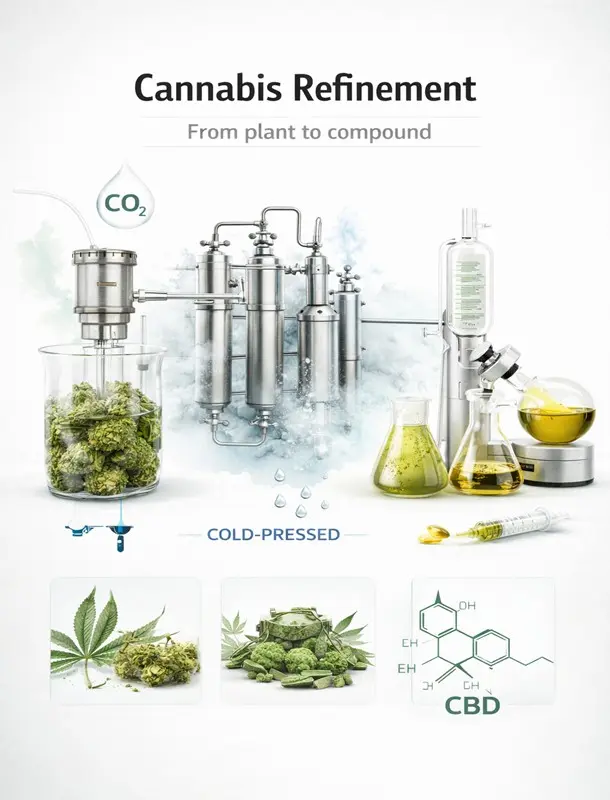
Raw biomass is bulky, perishable, inconsistent, and low-density. Extraction and refining change the product fundamentally. The same plant material is transformed into standardised oils, distillates, isolates, and concentrates, high-density, stable, and formulation-ready inputs.
This stage typically doubles or triples the value of the raw material. Depending on yield efficiency, refinement level, and market access, the processing layer moves into a range of R60 billion to R120 billion. The jump is not mere price inflation; it reflects a shift from selling weight to selling usable, measurable active compounds suitable for regulated supply chains, pharmaceutical applications, and wellness products.
Variability remains high at this point, influenced by biomass quality, extraction technology, and compliance standards, but the direction is clear: value concentrates as non-essential plant matter is removed and the functional core is isolated.
Retail, Distribution & Consumer Layer
On the demand side, South Africa can sustain 5–8 million regular adult-use consumers alongside 1–2 million medical patients. With repeat purchasing of standardised products (oils, edibles, vapes, and topicals) at R200–R350 per unit monthly, the visible retail layer settles at R25 billion to R35 billion annually.
This is the number most often quoted in public discourse, yet it represents only the final, consumer-facing slice of the value chain. The real industry is far broader.
The Full Economic Footprint
When all layers are combined, cultivation, extraction, formulation/manufacturing, distribution, retail, plus the dense supporting ecosystem of packaging, testing, logistics, compliance, legal services, security, software, and research, the total industry value expands significantly.
A realistic combined footprint sits between R80 billion and R150 billion under current constrained conditions, with a fully optimised system capable of exceeding R300 billion per annum. This includes:
Overlaying this are substantial secondary flows: R30–R60 billion in potential tax revenue (VAT, excise, corporate), R20–R80 billion from exports (hard currency inflows), and R10–R30 billion from cannabis-related tourism and wellness experiences.
Two Complementary Demand Streams
The industry rests on two interdependent pillars:
Both rely on the same critical middle layer: lawful refining and distribution. Without it, supply and demand remain disconnected, precisely the structural gap H3 Legal Solutions highlighted in its formal presentation to the Portfolio Committee on Trade, Industry and Competition (DTIC) on 6 March 2026.
Why This Matters Now
South Africa already has the foundational elements: constitutional recognition of private use, the Cannabis for Private Purposes Act, and the National Cannabis Master Plan. Market activity exists at scale. What is missing is the integrated operational framework that connects lawful cultivation to lawful access.
The informal market has not waited for perfect policy, it has filled the gap. Bringing that existing activity into the formal, taxable, and regulated economy is no longer a question of “if” but “how” and “how quickly”.
A phased, evidence-based approach, tiered licensing, controlled pilot supply models, improved inter-departmental coordination between Agriculture, Health, and Trade, and robust data systems, can close the gap without requiring wholesale legislative overhaul.
From Plant to Platform
Cannabis is more than a crop or a consumer product. It is a platform that activates agriculture, advanced manufacturing, healthcare, FMCG, tourism, and a wide support economy simultaneously. Value is not simply added at each stage, it is redefined: from bulky biomass to concentrated compounds to trusted, dosed consumer goods.
When measured as a complete continuum rather than isolated layers, the South African cannabis sector emerges as a genuine national asset class, capable of generating hundreds of billions in economic activity, creating jobs across skill levels, driving rural development, generating fiscal revenue, and earning foreign exchange.
The constitutional debate is settled. The policy direction exists. What remains is execution.
The real value of South Africa’s cannabis industry will ultimately be determined not by how loudly we talk about it, but by how effectively we build the missing middle, the lawful pathways that allow the plant to move from soil to science to shelf in a regulated, inclusive, and competitive manner.
Charl Botha is a legal strategist with a B.Proc degree, cannabis policy specialist, and co - founder of H3 Legal Solutions (Pty) Ltd. He has briefed Parliament and writes on the practical alignment of constitutional rights, industrial policy, and responsible cannabis commercialisation in South Africa.
#CannabisReform #NationalCannabisMasterPlan #Bioeconomy #PolicyExecution #H3LegalSolutions #Healthpath24 #HP24




Share this page with your family and friends.