
Notifications
7 minutes, 20 seconds
-574 Views 0 Comments 0 Likes 0 Reviews
The recent parliamentary proceedings on the National Cannabis Master Plan made one thing crystal clear: the biggest hole in South Africa’s cannabis framework is the complete absence of a regulated system for buying and selling the plant.
Government officials stated it plainly. Licensing for trade is required, yet existing legislation does not provide for it. The Business Licensing Bill is being looked at as a possible vehicle, but cannabis is not included.
Everyone agrees the need is urgent.
Legalising trade is listed as a priority. Yet the long-term legislative process offers no immediate mechanism to make it happen. That gap between stated urgency and actual delivery is now impossible to ignore.
Look at the impact on traditional and small-scale growers. Current pathways simply do not work for them. Hemp rules exclude them because of THC thresholds.
Medical licensing is out of reach because of the high costs and compliance burden. As a result, a large slice of existing cultivation stays outside the legal system altogether. These producers are not refusing to join the regulated space, there is simply no accessible door for them to walk through.
The proceedings did not leave the solution vague. Practical proposals were put on the table: declare specific geographic cultivation zones, recognise landrace cannabis varieties, and issue permits based on historical cultivation practices.
These are not theoretical ideas. They reflect the real agricultural picture on the ground.
Zoning is not just an economic or regulatory fix, it is a biological necessity. Cannabis is wind-pollinated. Pollen can travel long distances. One pollination event from a neighbouring crop can ruin an entire harvest by triggering seed production and slashing cannabinoid levels.
For legacy farmers guarding generational landrace strains, this risk is existential. Without clear zones separating hemp from high-resin cannabis, the system does not merely exclude traditional growers, it actively threatens the very genetics it claims to protect.
The same pattern appears with indigenous knowledge. Government acknowledges the value of cannabis knowledge held in communities and points to the Indigenous Knowledge Act as the right tool. Yet that tool remains unused inside the cannabis framework. Recognition exists in principle, but not in enforceable practice.
Religious use faces the same disconnect. Rastafari communities still operate in legal uncertainty despite court rulings and parliamentary processes.
Complexity is repeatedly cited as the reason for slow progress multiple departments, overlapping mandates, layered laws. But the hemp sector proves coordinated delivery is possible. Thousands of permits issued, provincial programmes running, export systems moving.
Hemp is advancing. Higher-THC cannabis is not. The contrast inside the same plant family is stark.
The long-term goal is not in dispute. Government wants to enable trade, support exports, and achieve full commercialisation. The Master Plan sits with the DTIC. The shift from prohibition to regulated industry is agreed in principle.
The constraint is execution.
Barriers to entry make the problem worse. Compliance costs, infrastructure demands, and international standards create a high wall that only well-capitalised players can clear. Without additional entry points, the market tilts toward big operators and leaves the majority behind.
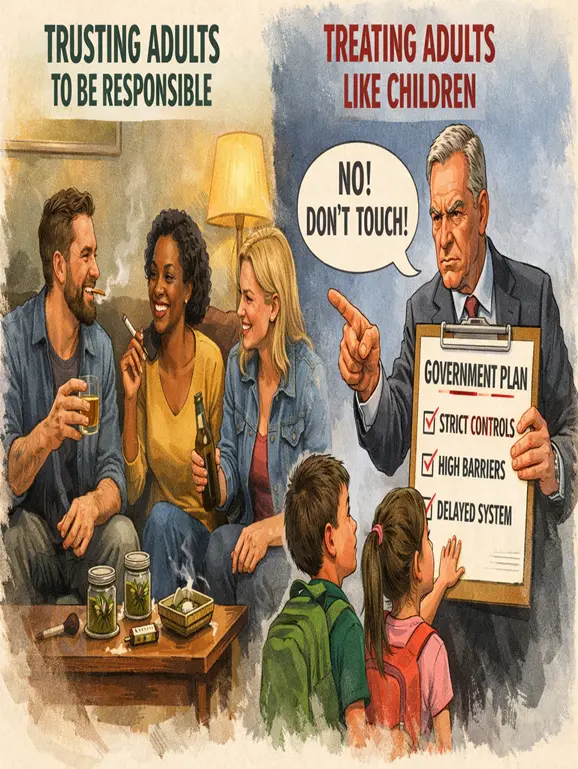
This stands in sharp contrast to how South Africa regulates alcohol and tobacco substances with proven public health risks, through controlled commercial models focused on access, taxation, and harm reduction rather than blanket exclusion.
Applying the same logic to cannabis would not remove oversight. It would simply recalibrate it: age-restricted sales, clear product standards, and enforceable distribution channels. The state could manage real risks while reducing the illicit market, lowering barriers, and aligning enforcement with practical reality.
The constitutional position supports this shift. In Minister of Justice and Constitutional Development v Prince, the Constitutional Court confirmed that adult use of cannabis in private is protected under Section 14 of the Constitution; the right to privacy.
Section 28(3) defines a child as a person under 18, making anyone 18 and older an adult in law. This is reinforced by the Children’s Act. Read together, the Constitution treats adults as rights-bearing participants entitled to make private choices, including cultivation and use of cannabis.
Extending this into a coherent regulatory framework moves us from implicit tolerance to explicit recognition.
The record from Parliament shows the challenges are defined, the solutions are on the table, and the intended outcomes are agreed.
The pressure point is now implementation.
A responsive approach would use an existing legislative vehicle to establish regulated trade without delay. It would activate inclusion mechanisms for traditional and small-scale growers based on the geographic zones and historical permits already proposed. It would bring indigenous knowledge into active protection.
It would clarify religious use. And it would match the pace of cannabis reform to the proven progress already achieved in hemp.
Positioning cannabis within an adult-use framework, the same model used for alcohol and tobacco changes the timeline completely. Instead of designing a new high-barrier system from scratch, the state can adapt existing licensing, retail controls, taxation, and enforcement mechanisms that are already operational.
Decision-making moves from years of uncertainty to targeted regulatory alignment in a matter of weeks.
The constitutional debate is settled. The policy direction is clear. What remains is delivery.
Charl Botha is a legal strategist with a B.Proc degree, cannabis policy specialist, and spokesperson for Team H3. He writes from direct involvement in parliamentary briefings, interdepartmental engagements, and regulatory submissions.





Share this page with your family and friends.